I’d like to begin this series on the origins and life of South African progenitor, Cornelis van Rooijen, with his place of origin, Gorinchem (Gorcum) in the Netherlands.
South African progenitor of the Van Rooyen family, Cornelis van Rooijen, hailed from Gorinchem in The Netherlands, a city used in defence of the Dutch Waterline, being at the junction of the Merwede and Linge Rivers, with the defensive line stretching from Naarden to Heusden. Gorinchem was a key stronghold, and the by the time of Cornelis’ birth (1695), the city lay secure behind its extensive fortifications and was at the tail end of the Nine Year’s War (1688–1697). The Nine Year’s War saw the Grand Alliance of the Dutch Republic, England, Spain, and the Holy Roman Empire, labouring to check French expansionism, and Louis XIV’s aggressive ambitions.
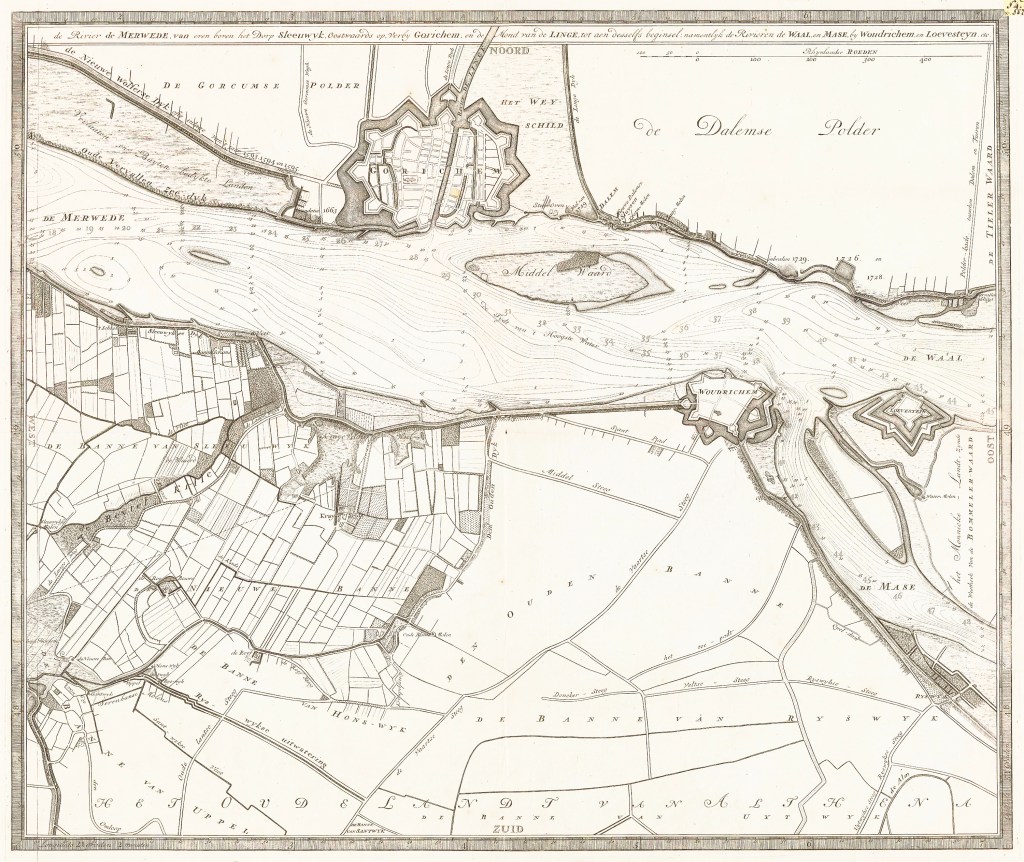
The military activity in the town had initially created economic prosperity, with a service economy arising, as well as growth in local industrial production by highly skilled people divided into guilds. They produced leather products, vinegar, soap and glass, among various other things. Alongside this they still practiced other trades, such as brewing, brickmaking and shipbuilding, a lucrative business. In the first half of the Seventeenth Century, the industrious citizens of Gorinchem had grown the footprint of the town from around 27 hectares to 56 hectares, a growth of 48 percent, and the population increased by 20 percent from 5 000 to 6 000 people, with the concomitant growth in housing.
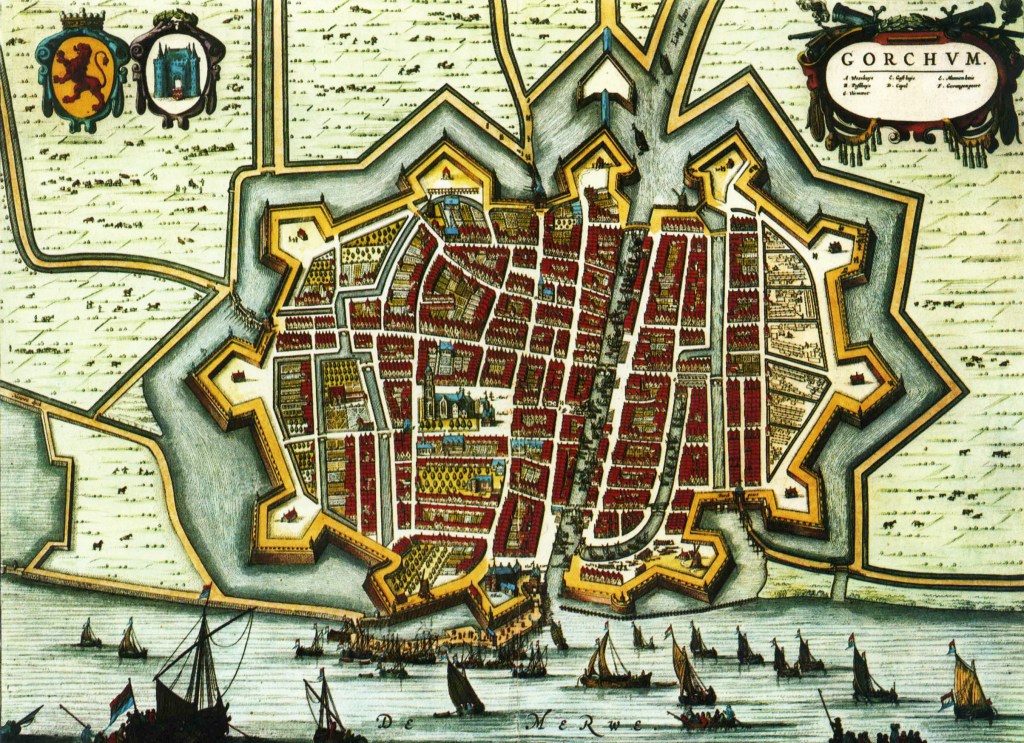
The Treaty of Ryswick in 1697 brought the war to an end but was little more than a stalemate. The residents of Gorinchem were depleted. Living in a garrison town is not an easy thing, and the demands on the populace was heavy with having to provide for the soldiers billeted there. The military presence was disruptive, taxation was a heavy burden, and the cost of everyday goods was rising. The Protestant faith was the dominant and state-sanctioned religion, which was a cause for some tension among other religious groups, such as Catholics. While there was a level of religious tolerance, you could not hold an official position unless you were Protestant. Further, anxiety was fairly constant as Gorinchem remained heavily fortified and issues in Europe were anything but stable.
The dawn of the Eighteenth Century saw sharp economic decline. Small towns like Gorinchem struggled to compete with large cities like Rotterdam and Amsterdam. With the ink barely dry on the Treaty of Ryswick the death of Charles II of Spain in 1700 ushered in the War of Spanish Succession in 1701 and the residents had to face another fourteen years of war. They could not have known how long this war might last, and it was a time of tremendous tension. The war would drag on until 1713 when the Treaty of Utrecht was signed. With this the garrison left the town and the service economy that had housed and fed the men saw their income dry up, as did specialised craftsmen. The town faced severe economic downturn.
Having the military garrisoned in the town he grew up in, Cornelis would have had exposure to the idea of military service, and some insight into what such a life might have been like. It was not a surprise that he would enter the service of the VOC, not only to support only himself, but to bolster family finances and helping to care for the large family at home in Gorinchem. Fixed contracts of three to five years meant some financial security, however modest, and a good dose of adventure might have been expected. This would likely have been an attractive prospect to a young man in an uncertain economic climate, and for whom there was limited opportunity.
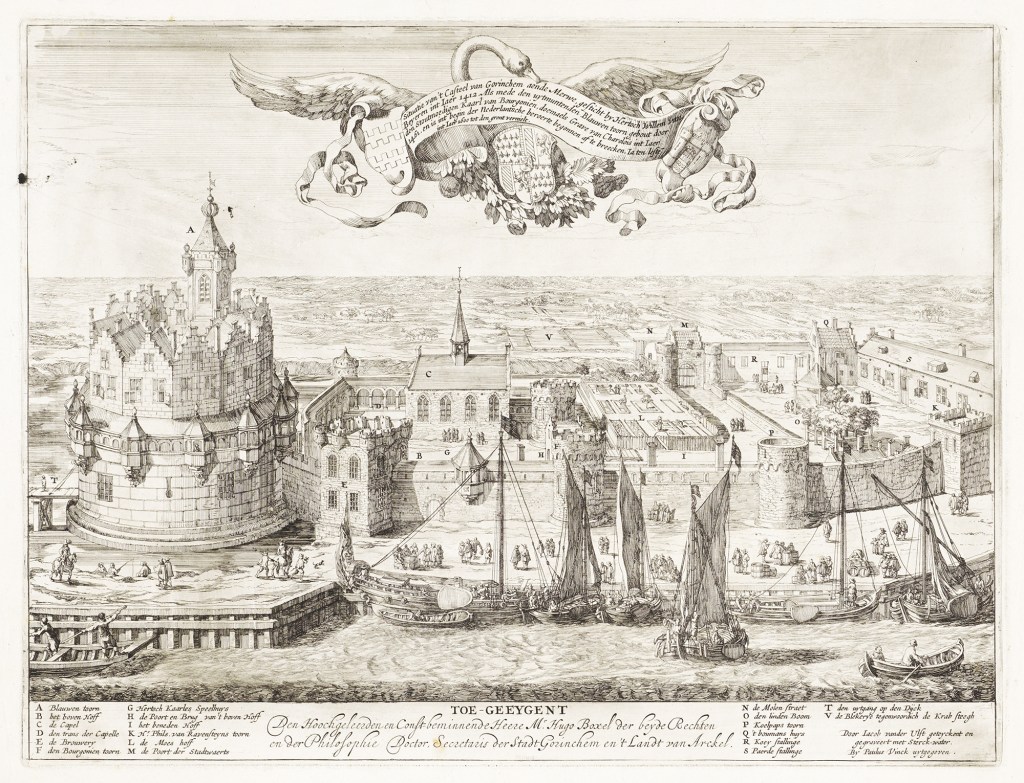
by Jacob van der Ulft (3)
Bibliography
Blaeu, Joan. 1649. Toonneel der Steden van de Vereenighde Nederlanden, met hare beschrijvingen. Amsterdam: Joan Blaeu. pp. 168–170.
Stamkot, Bert. 2006. En Gorcum rijst van ver… negentien artikelen over de geschiedenis van Gorinchem. Den Haag: CIP-gegevens Koninklijke Bibliotheek.
Stamkot, Bert. 1982. Geschiedenis van de stad Gorinchem. Gorinchem: Stichting Merewade.
Tissink, Fieke; De Wit, HF. 1987. Gorcumse Schilders in de Gouden Eeuw. Gorinchem: Stichting Merewade.
Internet Sources
- Archaeology in Gorinchem: Municipal depot for archaeology. https://www.archeologiegorinchem.com/en/ [accessed 29 March 2026].
- Blaeu, Joan. Toonneel der Steden. Available via Special Collections, Utrecht University. https://www.uu.nl/en/special-collections/collections/maps-and-atlases/town-plans/toonneel-der-steden-by-joan-blaeu [accessed 29 March 2026].
- Steenhard, Rens. 2017. Carnegie Foundation: Peace Palace Library. The Treaties of Ryswick (1697). 17 August. https://peacepalacelibrary.nl/blog/2017/treaties-ryswick-1697#:~:text=In%201697%2C%20the%20Huis%20ter,Peace%20between%20France%20and%20England [accessed 29 March 2026].
- Goodlad, Graham. 2025. The Nine Years War: 1688–1697. The Past. https://the-past.com/feature/the-nine-years-war-1688-1697/ [accessed 29 March 2026].
Image Sources
- Cruquius, Nicolaas. 1729. Map: Staten van Holland. De Rivier de Merwede, van ontrent de Steenen-hoek, Oostwaards-op tot verby het dorp van Sleeuwyk : met den Ouden-Wiel, en de Killen, die uit deselve na den Bies-Bos afloopen etc via Utrecht University https://objects.library.uu.nl/reader/1874-274055?page=2 [accessed 29 March 2026].
- Blaeu, Joan. 1649. Toonneel der Steden van de Vereenighde Nederlanden, met hare beschrijvingen. Amsterdam: Joan Blaeu. pp. 169.
- Van der Ulft, Jacob. 1656. De Blauwe Toren, Gorinchem. Rijksmuseum Collection. Available via Wikimedia Commons https://commons.wikimedia.org/wiki/File:RP-P-OB-66.670_Jacob_van_der_Ulft_-_De_Blauwe_Toren,_Gorinchem_-_collectie_Rijksmuseum.jpg [accessed 29 March 2026].

 van Rooyen Genealogy

Leave a comment