

Like many young men of his time Cornelis faced the prospect of an uncertain future if he remained in Gorinchem. He signed up with the VOC (Verenigde Oostindische Compagnie) in late 1713.
Politics and economic situation in 1713
A number of wars had taken place over the decades leading up to the time Cornelis was recruited in 1713, the most recent having been the War of Spanish Succession, which ended in the same year with the signing of the Treaty of Utrecht.

Fig. 1: Anglo-Dutch Fleet capture a Spanish treasure fleet at Vigo Bay, 12 October 1702 (‘De Slag bij Vigo’, Ludolf Bakhuizen, ca 1702)
Prolonged warfare caused tremendous economic strain. The Dutch transitioned into peacetime with their international power weakening. While they had unseated the Portuguese, their main rival when they dominated the trade in the East Indies, the cracks were beginning to show. The British East India Company was formed in 1600 and the VOC in 1602, but the former had not presented a true threat to the VOC interests in the early stages, but by 1713 their aggressive expansion threatened the VOC’s global reach and dominance. By extension this saw a decline in Dutch power. The VOC decline was not helped by a bloated and corrupt bureaucracy, rising costs and decreasing profit.
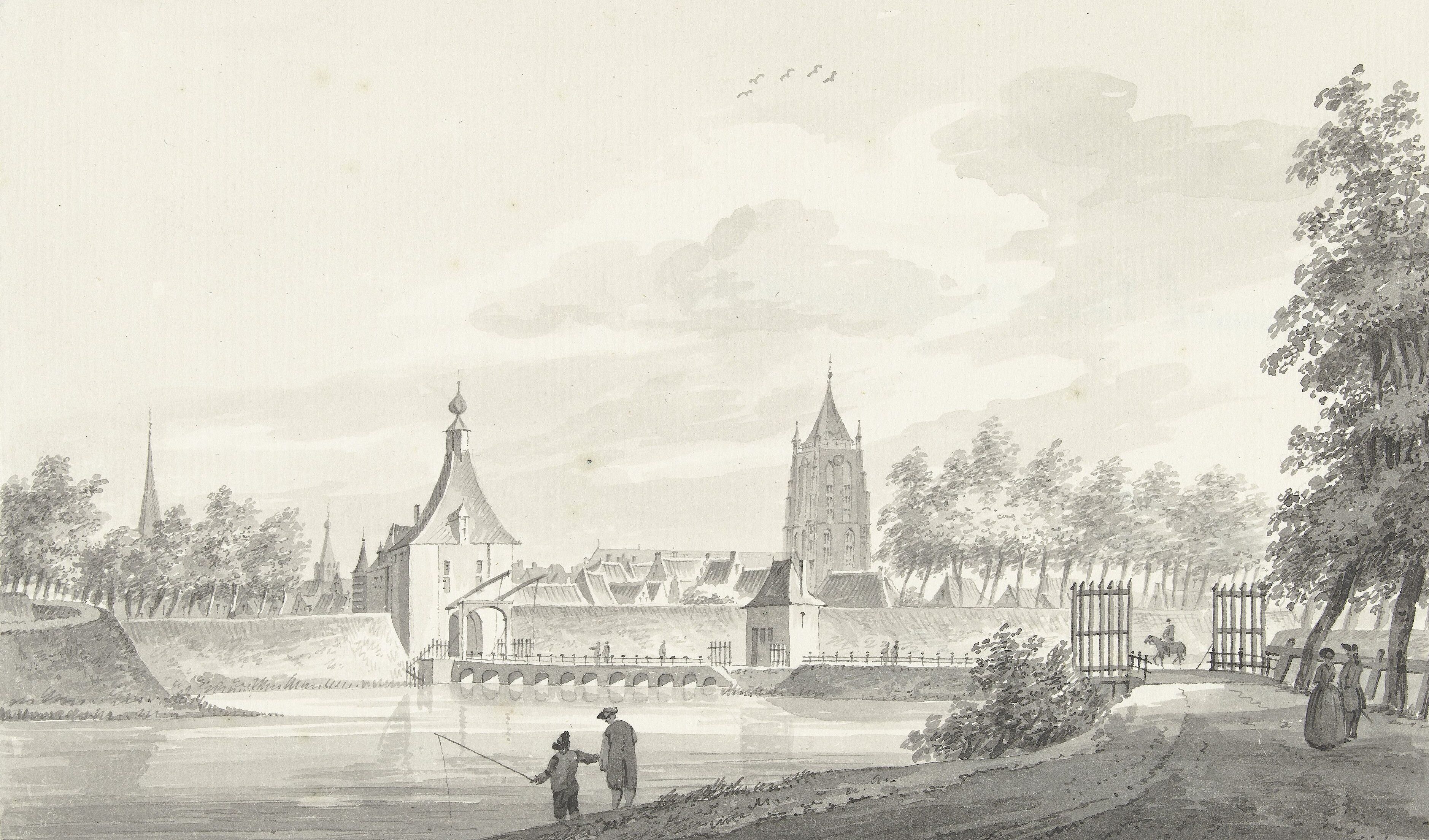
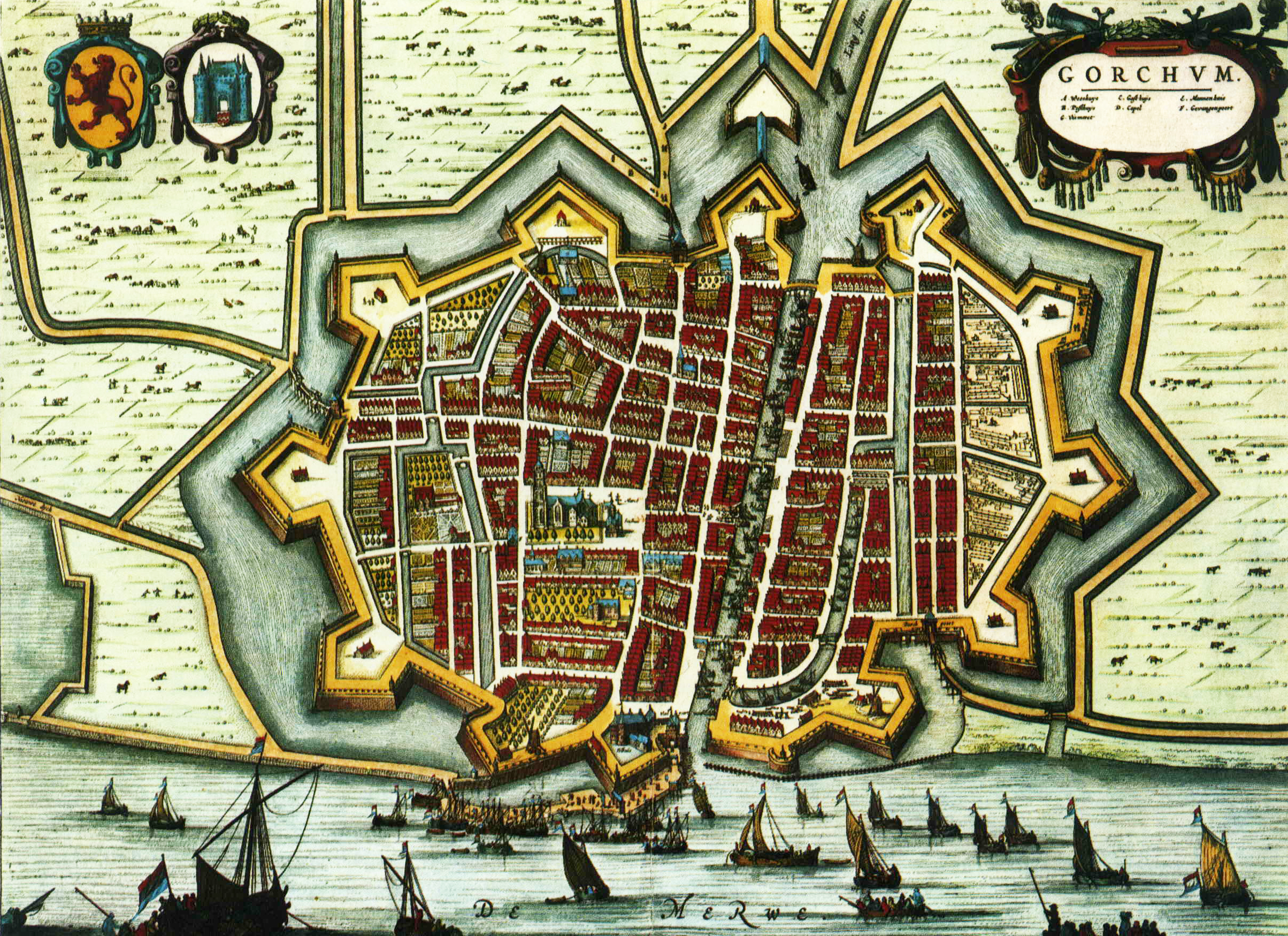
Local to Cornelis’ family, Gorinchem relied on trade in textiles, tanning, fish and grain, using river traffic along the Merwede and Linge rivers. Their commerce became increasingly less profitable affecting household income severely.
The Dutch were saddled with huge wartime debt, and small towns like Gorinchem strained under the burden of heavy excise duties on everyday necessities such as bread, beer and salt to fund this. Dutch economic recovery was slowed by a huge portion of state revenue only servicing debt.
The VOC
With the difficulty in affording daily essentials, and shortages, young men enlisting with the VOC was a lifeline to struggling families.
The VOC was divided into six regional chambers (Amsterdam, Delft, Enkhuizen, Hoorn, Rotterdam and Zeeland) which operated on a federated basis with each responsible for raising its own capital, recruiting men and getting their ships on the water. The structure was overseen by the Lords Seventeen.
The VOC continued to recruit as many men as possible across Europe, from the Lowlands, German-speaking countries, Baltic, Scandinavia and so forth. Agents were paid a commission or fee and provided an important service to the VOC and men seeking opportunity. At times the agents would advance much-needed cash to those enlisting and be reimbursed by the relevant chamber.
The men were required to sign contracts binding them in service to the company for 3–5 years. They would often sign a maandbrief (monthly wage letter) which provided a pre-agreed portion of their wages to their families.
Cornelis enlisted with the chamber of Zeeland and was assigned to the ship Middelwoud as adelborst (midshipman). His monthly wage was ten guilders.

Fig. 2: Page from the soldijenboek (wage book) for Cornelis van Roijen
He elected to cede 3 monthly payments per annum to his mother, Feijke Vermeulen per the maandbrief signed 12 October 1713.

Fig. 3: Maandbrief ceding 3 monthly payments per annum to Feijke Vermeulen
The translated text of the maandbrief reads as follows:
The Lord Directors of the East India Company, Chamber of Zeeland, were at my request the undersigned Cornelis van Roijen of Gorcum sailing as midshipman on the ship called Middelwoud requested and prayed that, so long as I shall be on the forthcoming voyage to the East Indies, to advance and pay by loan and on account to my mother Feijke Vermeulen three months out of my earned annual wages up to ten guilders per month from time to time, so that when the ship’s books, my accounts or other sufficient documents shall have been received, whereby it will be known what I shall be due from my earned wages, which His Honor shall provide to her for good payment. The undersigned hereof signed the 12 October 1713.
Cornelis van Roijen
With the knowledge of the Directors
Cornelis was given an advance of two months’ wages on 14 October 1713, the same day the Middelwoud raised anchor at Wielingen outbound to Batavia.
What is unusual is that on the page indicating the accrued wages for Cornelis’ period of service (1714–1722) no claim was made for the three months’ that should have gone to his mother. When he received his letter of freedom in 1722 it totalled 270 guilders, 12 stuivers and six duiten. He made no claim on this money either.

Fig. 4: Wage credits accrued from 1714–1722 for Cornelis van Roijen
The ship Middelwoud
The Middelwoud was a frigate of 804 tonnes, 145 feet (about 44m) in length, with the capacity to carry 175–250 persons. She was built in the VOC Zeeland chamber shipyard at Middelburg in 1712.

Fig. 5: Shipyard of the Zeeland chamber of the VOC at Middelburg
While technically frigates were warships, the VOC often used them as fast merchant vessels (retourschip, also East Indiamen), swiftly moving cargo as needed, and able to defend themselves, or other ships in their fleet, commonly sporting between 28–36 guns on a single, enclosed deck. Pirates, privateers and enemy nations were a constant threat.

Fig. 6: The later ship Noord-Nieuwland (broadly similar to Middelwoud) in Table Bay
The Middelwoud set out on her maiden voyage departing Wielingen bound for Batavia on 14 October 1713 in a fleet that included Prins Eugenius, Cockenge, and Nesserak.
She arrived at the Cape of Good Hope on 29 January 1714. When she raised her anchor for the next leg of her journey, Cornelis van Roijen would not be on board. He would be one of fourteen men to remain at the Cape.
Next time: Voyage to the Cape of Good Hope.
Acknowledgements: Thanks are extended to Corney Keller for sharing his knowledge of the VOC and the subject of ship wage books.
Bibliography
Bryan, T.J. 2025. The Dutch Empire: Mechanisms of Elite Control Through Corporate Sovereignty, Financial Innovation, and Maritime Law (1581–1795). Uploaded 18 Oct 2025. Internet Archive.
Gaastra, Femme Simon. (translator Daniels, Peter). 2003. The Dutch East India Company: Expansion and Decline. Zutphen: Walburg Pers.
Israel, Jonathan Irvine. 1989. Dutch primacy in world trade, 1585–1740. Oxford: Oxford University Press.
Stamkot, Bert. 1982. Geschiedenis van de stad Gorinchem. Gorinchem: Stichting Merewade.
References
De VOCsite. Schepenindex: Middelwoud (1712). https://www.vocsite.nl/schepen/10693 [accessed 6 May 2026].
Huygens Instituut. The Dutch East India Company’s shipping between the Netherlands and Asia 1595–1795. https://resources.huygens.knaw.nl/das/detailVoyage/93260 [accessed 6 May 2026].
Keaton, Julian. 2025. The War of Spanish Succession (1701–1714) and its European impact. HyperHistory. https://hyperhistory.org/the-war-of-spanish-succession-1701-1714-and-its-european-impact/ [accessed 6 May 2026].
Nationaal Archief: 1.04.02 Inventaris van het archief van de Verenigde Oost-Indische Compagnie (VOC) 1602–1714. 12754 Middelwoud: Grootboek, 1713–1714. Wage account Cornelis van Roijen. Images 326–333. https://www.nationaalarchief.nl/onderzoeken/archief/1.04.02/invnr/12754/file/NL-HaNA_1.04.02_12754_0326 [accessed 6 May 2026].
Naval Encyclopedia: Classic Frigates. 2019. https://naval-encyclopedia.com/enlightenment/classic-frigates/ [accessed 6 May 2026].
Van Rossum, Matthias. 2013. ‘Werkers van de wereld: Globalisering, maritieme arbeidsmarkten en de verhouding tussen Aziaten en Europeanen in dienst van de VOC.’ Thesis, Vrije Universiteit Amsterdam.
Image Sources:
Fig. 1: Bakhuizen, Ludolf. Ca 1702. ‘De Slag bij Vigo’. Wikimedia Commons https://commons.wikimedia.org/wiki/File:Battle_of_Vigo_Bay_1702.webp [accessed 6 May 2026].
Fig. 2: Wage account for Cornelis van Roijen. Nationaal Archief: 1.04.02 Inventaris van het archief van de Verenigde Oost-Indische Compagnie (VOC) 1602–1714. 12754 Middelwoud: Grootboek, 1713–1714. Image 326. https://www.nationaalarchief.nl/onderzoeken/archief/1.04.02/invnr/12754/file/NL-HaNA_1.04.02_12754_0326 [accessed 6 May 2026].
Fig. 3: Maandbrief ceding 3 monthly payments per annum to the mother of Cornelis van Roijen, Feijke Vermeulen. Nationaal Archief: 1.04.02 Inventaris van het archief van de Verenigde Oost-Indische Compagnie (VOC) 1602–1714. 12754 Middelwoud: Grootboek, 1713–1714. Image 327. https://www.nationaalarchief.nl/onderzoeken/archief/1.04.02/invnr/12754/file/NL-HaNA_1.04.02_12754_0327 [accessed 6 May 2026].
Fig. 4: Wage credits accrued from 1714–1722 for Cornelis van Roijen. Nationaal Archief: 1.04.02 Inventaris van het archief van de Verenigde Oost-Indische Compagnie (VOC) 1602–1714. 12754 Middelwoud: Grootboek, 1713–1714. Image 333. https://www.nationaalarchief.nl/onderzoeken/archief/1.04.02/invnr/12754/file/NL-HaNA_1.04.02_12754_0333 [accessed 6 May 2026].
Fig. 5: Udemans, Willem. 1757–1760. ‘Gezicht op de scheepswerf van de VOC te Middelburg, 1757’. Wikimedia Commons https://commons.wikimedia.org/wiki/File:Gezicht_op_de_scheepswerf_van_de_VOC_te_Middelburg,_1757_De_scheeps_timmerwerf_der_Oost_indische_Compagnie_te_Middelburg_%28titel_op_object%29,_RP-P-AO-15-60.jpg [accessed 6 May 2026].
Fig. 6: Artist unknown. Ca 1762. ‘The Noord-Nieuwland in Table Bay, 1762’.Iziko William Fehr Collection held at the Castle of Good Hope, Cape Town. Wikimedia Commons https://commons.wikimedia.org/wiki/File:Anonymous_The_Noord-Nieuwland_in_Table_Bay,_1762.jpg [accessed 6 May 2026].




Leave a Reply